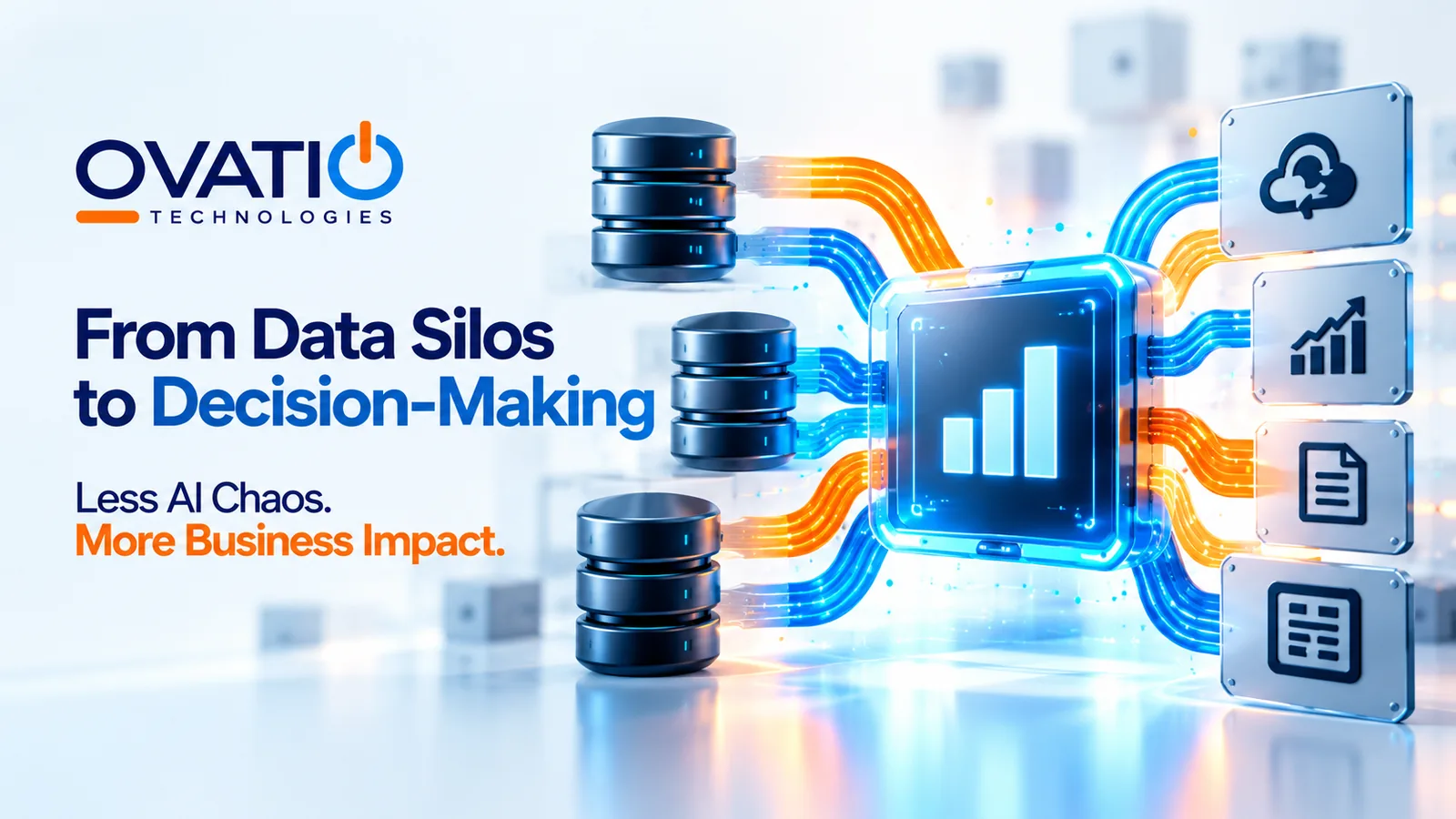
The information a business needs to make a decision often already exists. The problem is getting to it. A customer question may require details from a CRM, a service platform, and a contract repository. An operational issue may span production systems, finance reports, and team knowledge that lives in documents.
For the people responsible for answering those questions, the work can become a familiar routine: search, request access, export, compare, and reconcile. By the time a complete picture emerges, the moment to act may have passed.
Connecting enterprise information changes that equation. The opportunity is not simply to bring more data into one place. It is to make relevant information easier to find, verify, and use when decisions need to be made.
Why Data Silos Persist
Enterprise data silos rarely appear because someone deliberately designed a disconnected business. They emerge as organizations grow. Departments select tools for specific needs, acquisitions introduce different platforms, and security requirements limit access to sensitive information.
Those boundaries can be appropriate. A finance system and a clinical system, for example, should not expose the same information to every employee. But boundaries between systems also create gaps in the questions people can answer without manual effort.
A technology company might have product documentation in one repository, customer support history in another, and internal incident notes somewhere else. Each system may work well on its own. Understanding a recurring customer issue across all three can still be slow.
The challenge is not necessarily that the enterprise lacks data. It is that the information is organized around systems rather than the decisions people need to make.
Connected Information Is Not the Same as One Giant Database
When leaders hear “data integration,” they may imagine a lengthy replacement project or a mandate to centralize everything. Neither is automatically necessary.
Depending on the systems and use case, organizations can connect relevant sources through supported integrations, search and retrieval layers, APIs, or carefully governed data pipelines. Different approaches offer different tradeoffs in freshness, performance, maintenance, and security.
The right design starts with a business question. What information is needed? Where does it originate? Who is authorized to see it? How current must it be? And how can a user verify that the answer is grounded in the right source?
This is especially important for AI-enabled search and question answering. A fluent response is not enough. Business users need to know whether the information is accurate, current, and appropriate for their level of access.
What Connected Knowledge Makes Possible
Consider a support leader investigating a sudden increase in escalations. Today, an analyst might gather ticket trends, compare release notes, and contact product teams for context. With appropriately connected knowledge, the leader could locate relevant evidence across those sources more quickly and follow links back to the underlying records.
Or consider a consulting organization preparing for a client renewal. The account team may need approved project deliverables, past commitments, and current service information. Making that knowledge easier to retrieve can reduce the time spent assembling context and allow more time for the client conversation.
These are illustrative scenarios, not claims about a particular customer deployment. Their value is in the change in workflow: less time hunting for context and more time interpreting it.
Connected information can also support intelligent workflows. An AI-enabled process may use authorized information to prepare a summary or recommend a next step. Whether it can take action, and when a person must approve that action, should depend on the workflow and its risks.
Trust Requires More Than Connectivity
Access to information is useful only when people can trust what they receive. That makes governance a design requirement, not a feature to add later.
Source attribution helps readers check an answer. Permission-aware retrieval helps prevent information from being shown to the wrong audience. Clear ownership and update practices reduce the risk of relying on outdated content.
Organizations should also test how a system behaves when sources disagree, a document is missing, or a question falls outside available evidence. A useful answer may sometimes be, “The information is insufficient.” That is preferable to unwarranted confidence.
NIST’s AI Risk Management Framework emphasizes managing AI risks in the context in which systems are used. For enterprise knowledge applications, that means assessing not only the model, but also the quality of its sources, the access boundaries, and the decisions its outputs may influence.
Start With the Decision, Not the Integration
Before launching a broad information-connectivity initiative, identify a decision that is repeatedly delayed by fragmented knowledge. Map the sources required to answer it and the employees authorized to use them.
Then define what improvement looks like. It might be less time spent finding supporting evidence, fewer manual handoffs, or faster preparation of a reliable answer. Pilot against those outcomes and verify that the access controls and source references work as intended.
This business-first approach is also how OvatioIQ Knowledge fits into the conversation: helping organizations make enterprise information more usable through connected, source-grounded knowledge experiences. Where a workflow needs to go beyond answering a question, OvatioIQ Agent may be relevant to coordinating subsequent steps, subject to the capabilities and controls configured for that use case. The source connections, refresh behavior, and permissions are defined and tested for the selected use case.
The real promise of connected enterprise information is not another dashboard or a larger collection of documents. It is the ability to ask better questions and act with better context.
Organizations do not have to erase every system boundary to make progress. They need to understand which information matters, connect it responsibly, and make the result useful to the people doing the work.
When information becomes easier to find and verify, decisions can become less dependent on the next spreadsheet, status meeting, or manual search.
Disconnected information should not determine how quickly your business can move. Explore how Ovatio approaches connected enterprise knowledge and more informed workflows.
Cut Through the Noise
Explore the Less AI Chaos campaign.
Get simulator access