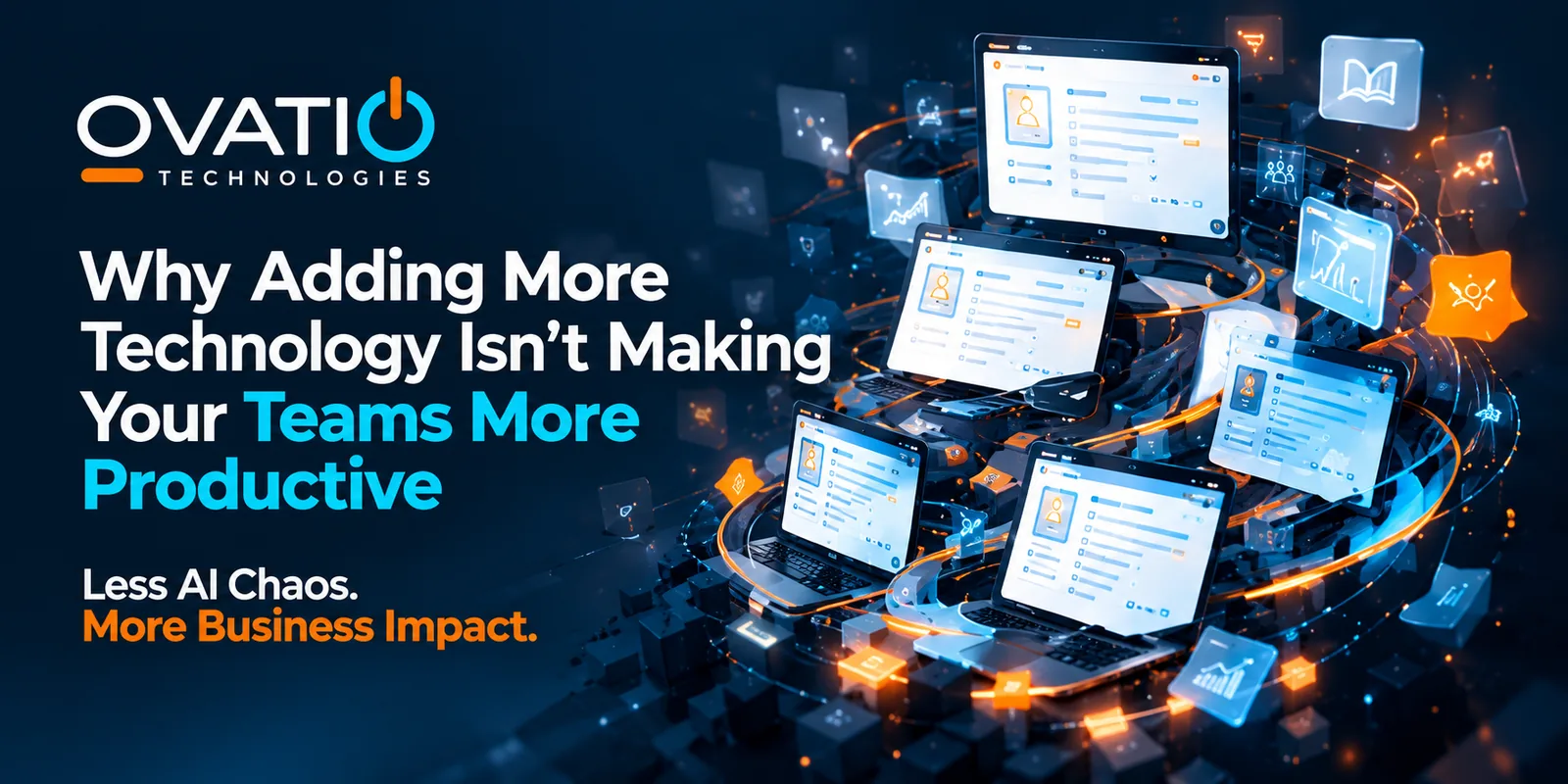
The enterprise technology stack was supposed to make work easier. Yet in many organizations, employees still spend too much time hunting for information, moving between applications, and recreating work that already exists somewhere else.
The instinctive response is often to buy another platform. A new productivity tool promises faster decisions. Another AI assistant promises fewer manual steps. A specialized application promises to close a gap the existing systems never quite addressed.
Sometimes those investments help. But when the underlying workflow remains fragmented, more technology can simply create more places for work to get stuck.
The question for leadership isn’t whether the organization has enough technology. It’s whether the technology it already has is making work meaningfully better.
The Productivity Paradox Inside the Modern Enterprise
Technology adoption and productivity improvement are not interchangeable. A team can adopt a new tool, report high usage, and still spend the same amount of time completing a critical process.
Consider an employee preparing a client update. The source information may live in a CRM, a project management platform, shared documents, and an internal messaging system. Even if each application works as designed, the employee must locate the relevant details, determine which version is current, and assemble the answer.
The problem is not necessarily the quality of any individual tool. It is the work required between them.
Research on digital work has repeatedly highlighted the fragmentation of employee attention. Microsoft’s June 17, 2025 Work Trend Index follow-up, Breaking down the infinite workday, describes a work environment shaped by constant interruptions and increasing demands on employees. That context helps explain why adding another interface is not automatically a productivity win.
How Technology Sprawl Creates Invisible Work
Technology sprawl rarely arrives as one major decision. It accumulates through departmental purchases, acquisitions, urgent fixes, and well-intentioned experiments. Over time, organizations can end up with overlapping applications and inconsistent ways of doing the same work.
The resulting friction often appears in ordinary activities:
- Employees enter the same information in multiple systems because data does not move reliably between them.
- Teams reconcile conflicting reports before they can make a decision.
- Managers request status updates because the information they need is difficult to find.
- Employees create spreadsheets or informal workarounds to bridge gaps between official tools.
None of these activities looks dramatic in isolation. Across a large organization, however, repeated small delays can consume meaningful capacity and make outcomes harder to measure.
The cost is not limited to time. Fragmented workflows can weaken accountability, complicate access management, and make it harder to know which information is trustworthy.
Why Another AI Tool May Not Fix the Problem
AI can help employees summarize information, answer questions, and coordinate work. But its value depends on the systems, data, and processes around it.
An assistant that cannot reach the information a team needs may produce incomplete answers. An automation built around an inefficient process may simply execute unnecessary steps faster. A tool introduced without clear ownership can create new approval and support requirements.
This is why leaders should resist treating AI adoption as a substitute for operational diagnosis.
Before introducing a new solution, ask: Where does work pause? Which handoffs require manual intervention? What information must be gathered before someone can act? And which existing tools already contain the capabilities needed to improve the process?
Sometimes the answer is better integration. Sometimes it is process redesign. Sometimes an AI-enabled capability genuinely changes what is possible. The distinction matters because each calls for a different investment.
Find the Friction Before Choosing the Fix
A useful starting point is to follow one important workflow from beginning to end, rather than evaluating applications one at a time.
For example, a professional services firm might examine the process of preparing a client deliverable. Where does the team retrieve previous project knowledge? Who validates the latest information? How many approvals depend on manual follow-up? Which tasks are repeated across engagements?
Mapping the workflow can reveal opportunities that are otherwise invisible in a software inventory. Leaders can then assess each opportunity against business impact, feasibility, information access, and risk.
This approach also creates a better basis for measurement. Instead of counting licenses or tool usage, organizations can evaluate cycle time, rework, manual handoffs, and the quality of completed work.
The aim is not to eliminate every application or centralize every dataset. It is to reduce the unnecessary effort required to get from information to action.
Making Existing Technology Work Harder for the Business
For enterprises with significant investments in established platforms, the next productivity gain may come from connecting what is already there.
When employees can access relevant, permission-appropriate knowledge across systems, they spend less time searching and more time using the information. When recurring handoffs are understood, suitable steps can be coordinated or automated without obscuring accountability.
At Ovatio, that is the perspective behind examining operational friction before recommending additional AI capabilities. OvatioIQ Knowledge is relevant where disconnected information makes answers difficult to find; OvatioIQ Agent may be relevant where a defined workflow can benefit from intelligent coordination. The right approach depends on the organization’s systems, controls, and actual business problem.
The important point is that technology should serve the workflow, not force employees to work around it.
Less Technology Friction. More Business Impact.
Enterprise productivity does not improve simply because the technology stack grows.
It improves when people can find what they need, complete work with fewer unnecessary steps, and make decisions with greater confidence. That may involve AI, but it begins with understanding the friction already embedded in the business.
Before adding another tool, look closely at the work your existing tools are creating.
Because the most valuable technology investment may be the one that finally helps everything else work better.
Disconnected tools and manual workarounds can hide the real opportunities for improvement. Explore how Ovatio helps organizations understand operational friction and identify where connected information and intelligent workflows can create business value.
Cut Through the Noise
Explore the Less AI Chaos campaign.
Get simulator access